Reach & Frequency
Part of Reach and frequency planning
Choosing a frequency objective from the communication task
Set a frequency objective that fits the message, decision window and available controls, then review actual exposure.
Choose a frequency objective by matching the minimum exposure, time window and buying control to what the communication must do. Set a review signal before launch so you can assess whether delivery and response fit the task.
Give repetition a job
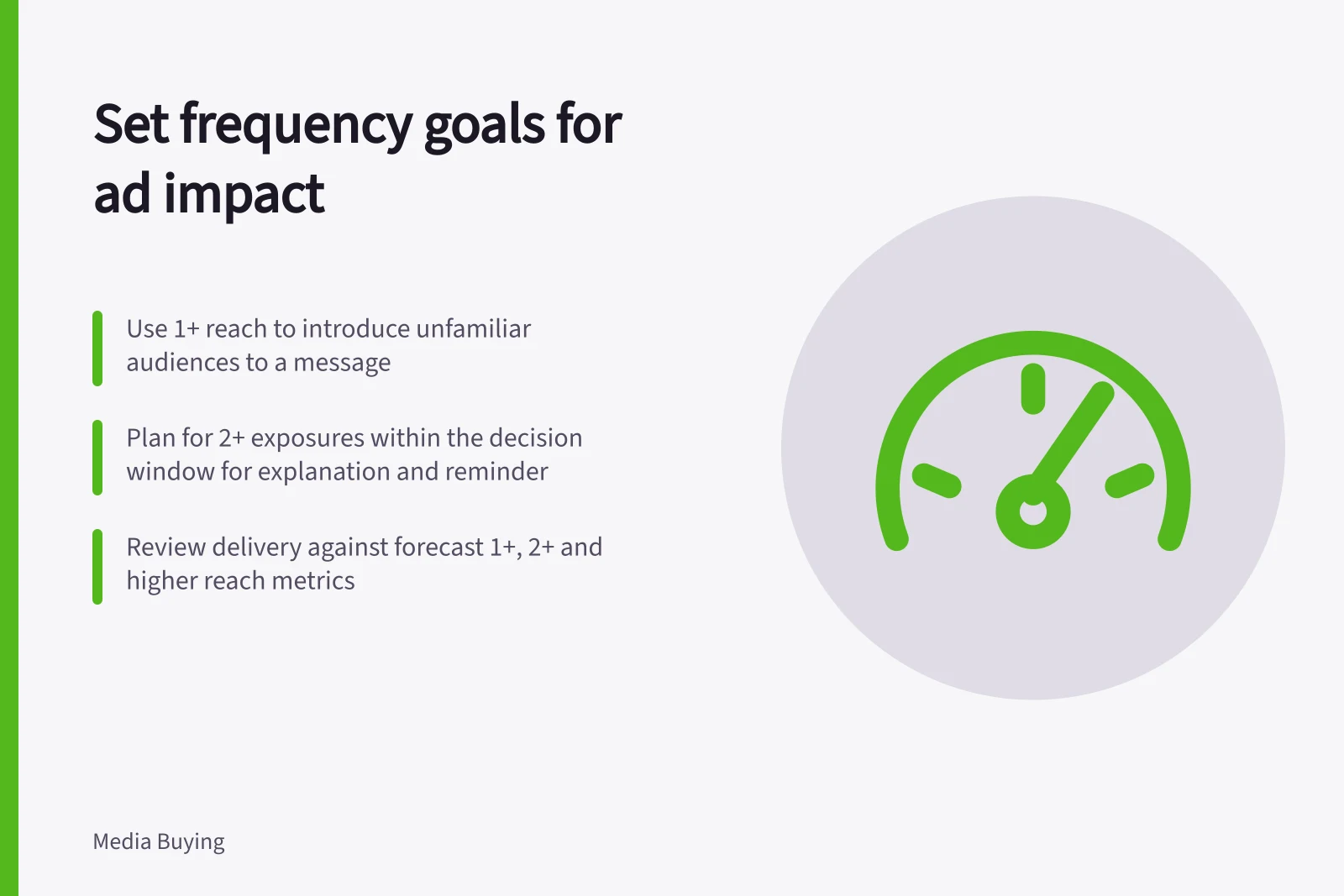
For a simple announcement to an unfamiliar audience, use broad 1+ reach as the starting objective: maximise the number of eligible people receiving at least one opportunity. When a message needs explanation followed by a reminder, use 2+ as a working minimum and plan for at least two opportunities within the decision window. Neither count proves an outcome.
For people already familiar with an offer, prioritise a timely reminder over broad introductory coverage. Don’t raise the minimum simply because the audience knows the offer; choose repetition only when another contact has a useful job.
Set the period to the time the audience has to act: use the task’s decision window rather than a standard duration. For an explanation followed by a reminder, allow enough of that window for both opportunities; for a timely reminder, end the window when the reminder ceases to be useful.
An illustrative objective is: “Reach as many eligible people as feasible at least twice during the four-week campaign, while reviewing the share served much more often.” Four weeks is an example, not a default for every task.
Examine the distribution
Average frequency can conceal concentration. An average of three could mean fairly even delivery, or many people receiving one impression while a smaller group receives far more. Ask for 1+, 2+ and higher reach where supported, and set an allowance for the higher-frequency tail that would prompt a review.
A counted impression does not show that someone understood or acted on the message. If the task is learning or persuasion, define a suitable response or brand measure separately. Don’t call a 2+ or 3+ delivery threshold “effective” without evidence that it matters for the intended outcome.
Match the control to the objective
A frequency cap limits counted impressions or views within a defined interval under the supplier’s rules. Use a cap when the objective needs a limit on repetition; it can restrain delivery but cannot ensure anyone receives the maximum.
For Google Ads, confirm what the available options — such as frequency capping, Target frequency and Reach Planner — do before including any of them in a plan.
A cap in one supplier’s system does not control ads bought from another. If audiences overlap, campaign-wide frequency may exceed either supplier’s figure; use a suitable combined measure where available, otherwise state that limit.
Review delivery and response
Keep the approved threshold, period, audience and control settings with the forecast. After launch, compare delivered 1+ reach, reach at the chosen minimum and the higher-frequency tail where data are available. Review a shortfall against the agreed delivery expectation or a tail above its planned allowance.
If delivery falls short, investigate eligibility, delivery or format restrictions before raising the target. Review the communication or business outcome separately; if repeated exposure grows without the intended response, investigate the message, audience and measurement before buying more repetition.