Measurement Design
Part of Marketing mix modelling for media decisions
Comparing model estimates with observed experiments
Align outcomes, spend changes, markets and uncertainty before comparing an MMM estimate with a media experiment.
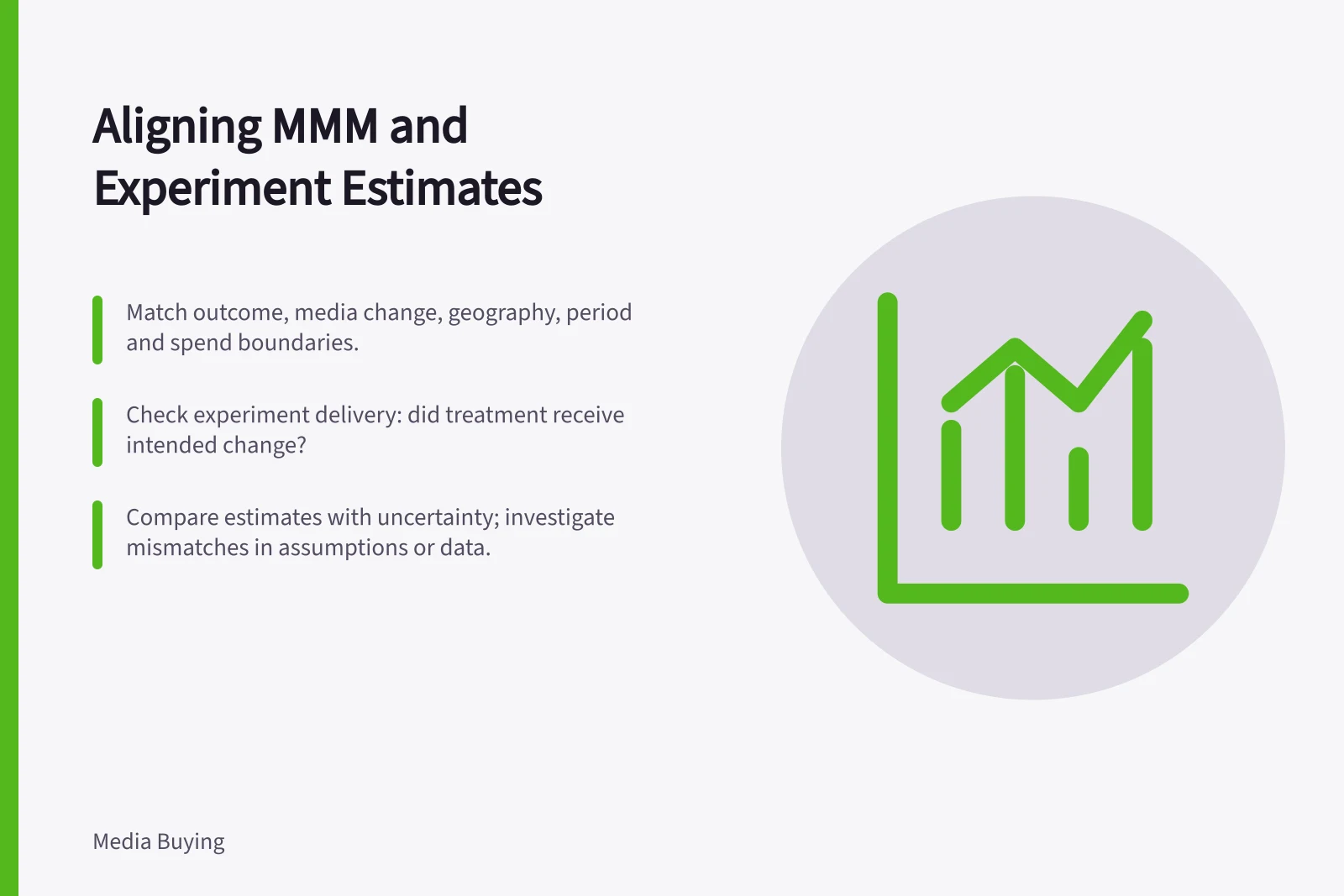
Only compare an MMM estimate with an experiment after aligning the outcome and media change each estimates. A credible experiment estimates the effect of its tested change in the assigned population and period. An MMM estimates an effect under its model and historical data. Agreement may add confidence; disagreement needs investigation.
Match the questions
Read the experiment record first: what changed between treatment and control—switching a channel on, pausing it or adding spend? Note which Australian markets or people were assigned, what media difference actually occurred, and which outcome and response window were analysed. Keep the estimate with its uncertainty.
Request the MMM estimate closest to that outcome, channel, geography, period and spend change. Total modelled channel contribution cannot be compared directly with a test of a small spend increase. A model's zero-spend counterfactual may also differ from an experiment's reduced-spend comparison. Carryover assumptions and observation windows can add further differences. State any mismatch rather than manufacturing a common return figure.
Alignment question / Why it matters
- Same outcome?
- Orders, revenue and qualified leads answer different questions.
- Same media change and baseline?
- Adding spend differs from assessing all existing activity.
- Same market and period?
- Demand, availability and delivery conditions can differ.
- Same cost boundary?
- A return ratio changes with the spend included.
- Comparable uncertainty?
- Point estimates alone hide imprecision.
Check the experiment that ran
Inspect assignment and delivery records: did treatment receive the intended difference, did tested activity reach controls, or did spend move elsewhere, and were outcome rules consistent? A noisy test may leave a wide range compatible with several model estimates.
An experimental control differs from an MMM's held-out outcome observations. Withholding observations from model fitting helps assess prediction on unseen data, but it does not create a treatment-control comparison or by itself validate a causal channel effect.
Interpret the comparison
Place both estimates, their uncertainty and their definitions in one review. Overlapping intervals alone do not prove that the methods agree or that their effects are equivalent. Judge whether the estimates support the same proposed spend decision and investigate material differences in delivery, period, geography, controls, data coverage and model assumptions.
An experiment may inform an MMM prior. If the same test was used to calibrate the model, agreement with that test is dependent evidence, not an independent validation. Record the calibration history and use another suitable test where an independent comparison matters. End with a decision tied to the proposed spend change and the evidence that could alter it.
Steps to Validly Compare MMM Estimates with Media Experiments
- Review experiment details firstIdentify the media change (e.g., channel activation), target markets in Australia, and response window used.
- Request aligned MMM estimateEnsure it matches the same outcome, channel, geography, period, and spend change with comparable uncertainty.
- Check experimental integrityVerify treatment assignment, delivery accuracy, and consistency of outcome measurement.
- Interpret both estimates togetherAssess overlap in confidence intervals and investigate discrepancies in delivery, controls, or assumptions.
- Use independent validation where neededAvoid relying on calibration tests for validation; use a separate experiment if independence is critical.