Measurement Design
Marketing mix modelling for media decisions
Learn how to use marketing mix modelling for media allocation, including the data, assumptions and checks needed before acting on an estimate.
Marketing mix modelling (MMM) can help estimate how media activity affects a business outcome and explore channel budget changes. Treat its results as conditional estimates. A useful recommendation depends on a consistent outcome, informative data, defensible causal assumptions and a proposed spend level the model can reasonably assess.
Begin with the decision
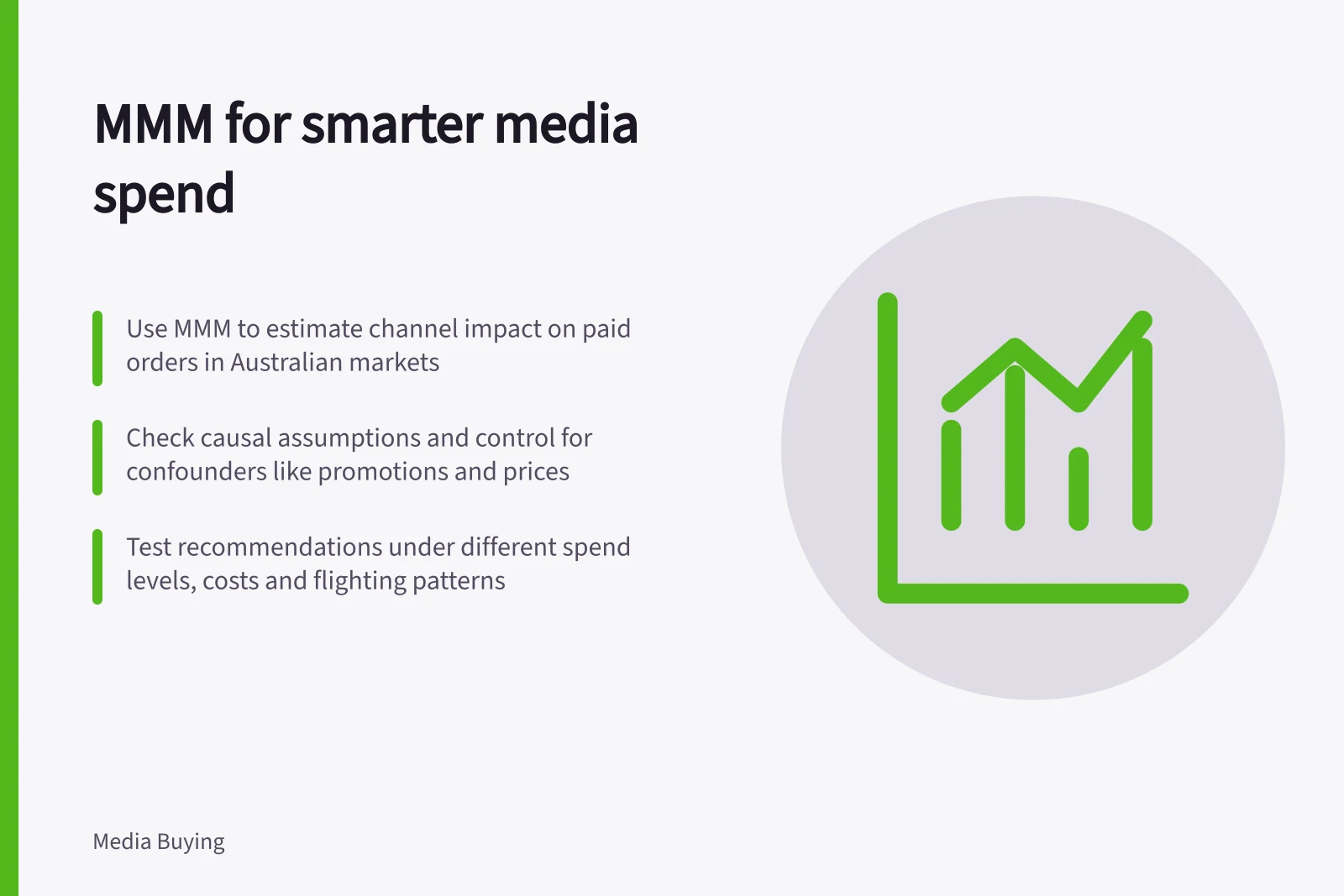
Name the choice the model must inform: moving part of an approved budget, continuing a channel or investigating a weak result. Define the outcome in the business record, such as paid orders or accepted enquiries in specified Australian markets. Agree on the period and the treatment of cancellations and duplicates.
Match the requested detail to the data. Channel-level activity may support a channel allocation question. It does not establish that a particular creative, placement or impression caused a sale.
Read the estimates in context
An MMM combines an outcome series with media activity and relevant business influences across time and, where suitable data exist, geographic areas. Some models represent effects that continue into later periods and diminishing returns as activity increases. Those choices affect the estimated return from a spend change.
| Output | Question it can inform | Limit |
|---|---|---|
| Channel contribution | What effect does the model estimate for observed activity? | The estimate depends on the model and its causal assumptions. |
| Response curve | How might the outcome change at different activity levels? | Spend outside the observed range calls for particular caution. |
| Marginal return | What is the estimated return from a further change at a stated spend level? | It differs from average return on past spend. |
| Budget scenario | Which allocation does the model favour under stated conditions? | It cannot account for a buying constraint that was left out. |
Demand may influence both sales and the decision to buy media. Promotions, prices and availability may also change alongside a campaign. Ask which relevant influences were included, which were unavailable and how those gaps affect the conclusion.
Test the causal claim
A causal estimate depends on which variables the model controls for, not just how closely its predictions match past results. A control should account for a factor that affects both media activity and the outcome; controlling for a variable on the pathway from media to the outcome can distort the effect being estimated.
Ask the modelling team to explain the causal logic behind its controls and whether any important confounders were unavailable. A model that predicts well on held-out data can still have weak causal estimates. Out-of-sample prediction is a preliminary check on model structure, not proof that media caused the measured outcome.
Check the evidence before changing spend
Confirm that outcome, media activity, spend and other inputs cover compatible dates and markets. Investigate missing periods, changed definitions, channels with little variation and channels that move together. Ask for uncertainty, plausible response curves and appropriate model diagnostics. A check on data held out from fitting can reveal prediction problems.
For a proposed allocation, record the total budget, channel limits, assumed media prices, flight dates, market and outcome value. Ask how the recommendation changes under plausible alternative assumptions.
Check booked inventory, creative capacity and the time needed to observe the result. If the proposal moves far beyond historical activity or modest assumption changes reverse the choice, make a smaller change or gather more evidence before approving it.
Make scenario assumptions explicit
A scenario is not determined by the allocation alone. Its estimated return can depend on the chosen time range and markets, the distribution of activity across dates and locations, media cost per unit, and revenue assigned to each outcome unit. Confirm that these settings reflect the decision being considered rather than simply carrying forward historical defaults.
Where future conditions differ from the past, state the difference explicitly. A channel may have a new unit cost, a changed flighting pattern or a different revenue value per KPI unit.
Treat response curves as evidence about the range the model has seen, not a guarantee beyond it. Meridian estimates its saturation curve parameters from observed media activity, and extrapolated results need particular caution. If a proposed spend level lies well outside that observed range, use the scenario as a weak guide rather than a precise forecast.
Key Data and Assumptions in MMM for Australian Marketers
- Outcome Metric
- Paid orders or accepted enquiries (Australian markets)
- Time Range
- Agreed period aligned with campaign cycles and business reporting
- Media Cost per Unit
- New unit costs must be explicitly stated if different from historical values
- Revenue per Outcome Unit
- Assigned value for KPI units (e.g., $X per order)
- Saturation Curve Basis
- Estimated from observed media activity; extrapolation requires caution
Approve with conditions
Before approving a recommendation, ask for the decision-specific estimate and the assumptions that produce it. Distinguish the estimated contribution of activity already observed from the marginal return on the proposed next change. Check whether the preferred allocation remains preferred when reasonable assumptions about cost, timing or outcome value change.
Results such as a very low or negative baseline, or one channel dominating all others, are reasons to seek an explanation rather than accept the ranking at face value. The model should inform judgement, not override known business conditions that it did not represent.
Record what the approval relies on: the outcome definition, included markets and period, scenario assumptions, relevant channel constraints, and the principal uncertainties. If an assumption changes before the media is committed, revisit the scenario; if the decision requires stronger causal evidence, an appropriately designed experiment may be needed.
In this guide
- Distinguishing a marketing mix model from attribution reportingSee what MMM and attribution reporting each measure, why their channel figures can differ, and which result suits a media decision.
- Checking whether available data can support modellingAudit outcome, media, spend, dates, geography, missing values and variation before using data for a marketing mix model.
- Reviewing assumptions before accepting a budget recommendationCheck an MMM budget scenario's outcome, costs, response curves, constraints and uncertainty before changing media spend.
- Comparing model estimates with observed experimentsAlign outcomes, spend changes, markets and uncertainty before comparing an MMM estimate with a media experiment.