Measurement Design
Part of Marketing mix modelling for media decisions
Checking whether available data can support modelling
Audit outcome, media, spend, dates, geography, missing values and variation before using data for a marketing mix model.
Data can support a marketing mix model (MMM) only if the outcome, media activity and relevant business influences can be assembled for compatible periods and markets, with enough variation to answer the proposed channel question. Audit those conditions before promising a precise estimate.
Inventory the series
Define the business outcome and its source: orders, revenue, accepted enquiries or another consistent measure. Check returns, duplicates and any change to its counting rule. List each channel's activity and spend, plus relevant promotions, prices, availability and demand indicators.
For each series, record owner, source, unit, geography, time interval and dates covered. State how daily exports will be aggregated if the model uses weekly outcomes. Reconcile channel definitions and spend with activity. For Australian cost comparisons, use a consistent AUD and GST basis or document differences.
| Check | Question | Response to a gap |
|---|---|---|
| Outcome | Was the same event counted throughout? | Repair or separate periods with changed definitions. |
| Media | Do activity and spend refer to the intended channels? | Reconcile exports and booking records. |
| Time and area | Do the series cover compatible periods and markets? | Align boundaries or narrow the question. |
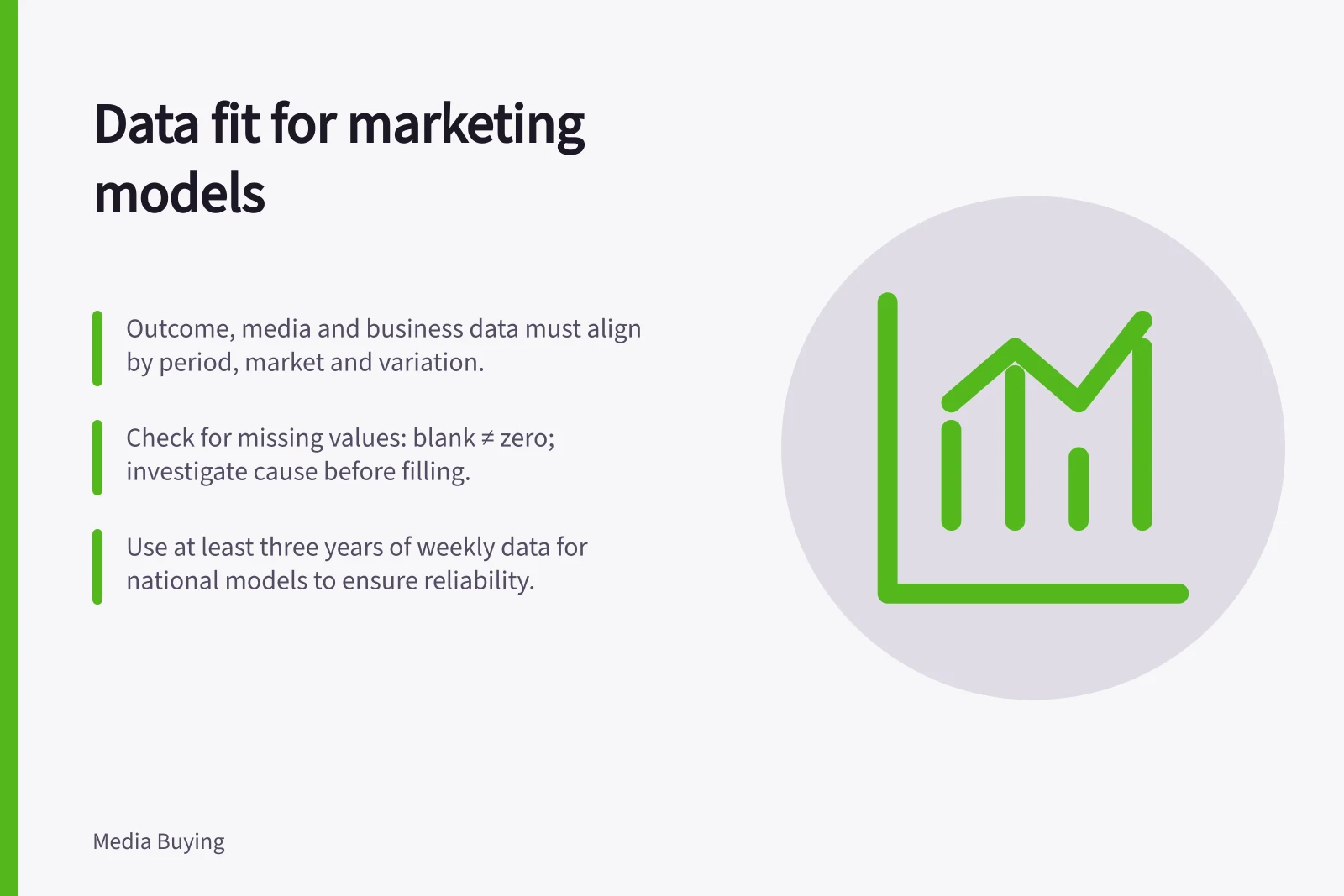
| Missing values | Does a blank mean no activity or an unknown value? | Establish the cause before filling it. |
| Variation | Did channels change separately enough to examine? | Combine channels or narrow the question where justified. |
| Other influences | Were material business changes recorded? | Collect suitable inputs or state the limitation. |
Test the signal
A confirmed inactive channel can have zero activity. A failed export is missing data, not zero activity. Missing outcome or control values need separate investigation and a documented treatment.
Plot the outcome, media and candidate influences over time and, where available, geography. Look for reporting breaks, outliers, long inactive periods, channels moving together, and business changes that coincide with spend. Geographic data can add useful variation, but sparse or inconsistent areas can weaken an estimate.
No number of weeks guarantees a useful model. Meridian's guidance illustrates that two years of weekly data can be too little for a national model in its example, and suggests using weekly data from three years instead. Sufficiency depends on the dataset.
Model complexity, variation and the width of resulting uncertainty matter more than meeting a bare count. If a national model has too many effects for its data, reduce unnecessary detail or gather better evidence; do not remove an important confounder merely to improve the ratio.
Key Data Requirements for MMM in Australia
- Recommended data duration (national model)
- Three years of weekly data
- Minimum acceptable time interval
- Weekly
- Consistent currency for Australian comparisons
- AUD with GST basis
- Critical factor beyond count
- Model complexity, variation, and uncertainty width
Record a readiness decision
Mark each input usable, repairable or unavailable, and state which requested estimates each gap affects. An outcome-definition break may undermine the whole period; a channel with little distinct activity may prevent a separate channel estimate. Exploratory checks and model results should then test whether uncertainty is narrow enough for the investment decision. If not, narrow the question or collect more evidence.