
Forecasting
Media forecasting and scenario planning
Build media forecasts with stated assumptions, compare cautious and optimistic cases, and set decisions for when costs or delivery change.
A media forecast estimates what a proposed buy might deliver under stated conditions. Scenario planning asks whether the spending decision still makes sense when those conditions change. Use the same audience, dates, cost boundary and outcome definition across cases, then identify the assumptions that would change the decision.
Decide what needs forecasting
Start with the decision: approve a flight, reserve more budget, change the mix or investigate whether a target is feasible. Forecast impressions and reach for an audience coverage question. Estimate enquiries or orders only when the outcome definition and available evidence support it.
Keep the measures distinct. Impressions count expected ad deliveries. Reach estimates distinct people under a stated method. A platform conversion forecast follows that platform’s action and credit rules; it is not automatically a forecast of accepted enquiries in the business record or of outcomes caused by advertising.
Key Metrics in Media Forecasting
- Impressions
- Expected ad deliveries
- Reach
- Distinct people exposed (under stated method)
- Frequency
- Average number of times an individual sees the ad
- Platform Conversion
- Platform-defined action (e.g., click, form submit) under its credit rules
Build a comparable base plan
Record the eligible Australian market, campaign period, placements, creative, media spend in AUD and GST basis. Include required production and service costs in the approval view, separately from the media spend used in a platform forecast. Note what is booked and what can still change.
Save each forecast with its settings and date. If a platform planning tool is used, record the tool, the settings applied and any limitations stated in its current documentation. Keep the record clear about what the forecast covers, so it is not mistaken for a measurement of actual delivery.
| Planning layer | Record | Decision it supports |
|---|---|---|
| Inputs | Audience, dates, inventory, spend and price basis | Is the proposal comparable with the brief? |
| Delivery | Forecast impressions, reach and frequency where available | Could the buy create the intended exposure? |
| Response | Assumed action rate and outcome definition | What result is plausible under those assumptions? |
| Constraints | Bookings, creative, capacity and reporting gaps | Could the proposed change be made? |
Change assumptions that matter
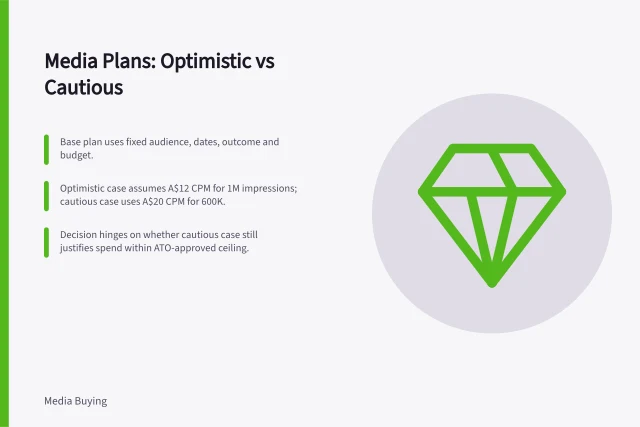
Create a base, cautious and optimistic case. Keep the objective and counting rules fixed. Change a small set of uncertain inputs with a reason: media price, eligible inventory, delivery or response. Label each input as a current quote, a supported tool estimate, relevant history or planning judgement.
Scenarios are conditional calculations, not confidence intervals or promised bounds. Related inputs should move together where appropriate: limited inventory may coincide with a higher price. If the decision works only in the optimistic case, identify what needs checking before committing spend.
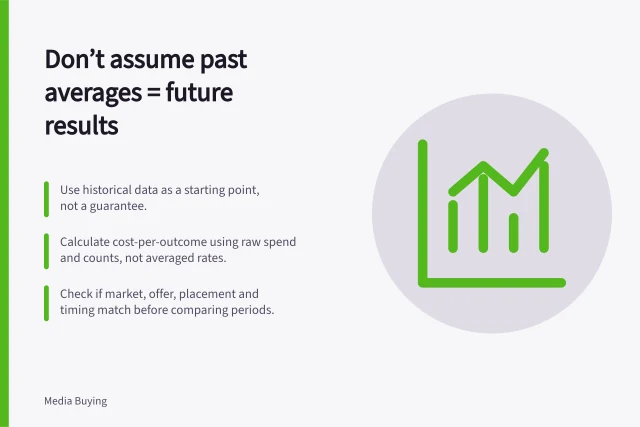
Historical averages need similar care. An earlier campaign may have used another offer, market, creative or attribution rule, so check that the basis is comparable before reusing it.
A marketing mix model can inform a different scenario: estimated incremental outcomes under a proposed media change. In Google’s Meridian, future estimates depend on the fitted model and assumptions such as media unit cost and flight pattern. Meridian forecasts the incremental outcome under a set of assumptions about the future and does not predict the future outcome value itself.
Media Forecasting Scenarios: Base, Cautious and Optimistic Cases
- Base Case
- Current assumptions: stable media prices, available inventory, standard response rate
- Cautious Case
- Higher media prices, limited inventory, lower response rate
- Optimistic Case
- Lower media prices, expanded inventory, higher response rate
Make future assumptions explicit
Meridian uses historical data for default assumptions in post-modelling analysis, including return on investment, response curves and budget optimisation. Check whether those defaults describe the future plan: revenue per KPI unit, such as unit price or lifetime value, may change, as may media cost or the distribution of media across channels, locations and time periods. New data can be incorporated to modify assumptions.
Keep scenario assumptions separate from model estimation. In Meridian, scenario planning changes post-modelling analysis metrics, not parameter estimation.
Define the metric before comparing cases. Meridian’s ROI depends on the selected time range and geographies, the flighting pattern, total media units per channel, cost per media unit and revenue per KPI. A difference in any of these settings can change the reported metric, so state which settings apply and avoid treating an ROI figure as independent of its calculation choices.
When future activity differs from the training period, record the specific difference rather than carrying history forward by default. For example, a channel introduced during the model training window may have a historical flighting pattern with zero activity or a ramp-up trend that is not expected to continue. Make the future flighting assumption explicit in the scenario.
Set a decision and review point
For each case, show the forecast delivery, outcome assumption, total amount committed and action it would justify. An approval could fund an initial flight while holding later spend until a current inventory quote and early delivery report are available. Record who can authorise a change.
After launch, compare actual settings, spend, price and delivery with the assumptions. Distinguish a changed input from a poor estimate. Update the remaining forecast and retain the original for the final review.
For model-based scenarios, keep the decision record clear about which assumptions come from historical data and which have been changed for future planning. Note which assumptions would need reconsideration if the plan changes.
Forecasting Timeline: From Planning to Review
- Planning Phase
- Build base plan with defined inputs, settings and assumptions
- Scenario Development
- Create cautious, optimistic and base cases with adjusted inputs
- Approval & Launch
- Commit initial spend; hold later phases pending delivery reports
- Post-Launch Review
- Compare actuals vs. forecasts; update remaining plan if needed
In this guide
- Building a media plan with optimistic and cautious assumptionsCreate comparable cautious, base and optimistic media plans, keep assumptions visible, and decide what evidence would change the buy.
- Estimating outcomes without treating historical averages as guaranteesUse past media results carefully: rebuild comparable rates, show changing conditions, and turn averages into conditional outcome estimates.
- Planning a response to rising inventory costsDiagnose higher media prices, recalculate delivery at the approved budget, and choose a response with its audience and cost trade-offs visible.
- Reviewing whether extra spend would add new reachCompare like-for-like reach forecasts at two spend levels, calculate the estimated marginal gain, and check frequency and model limits.