Supplier Evaluation
Media procurement and contracts
A practical guide to approving media commitments, costs, account access, delivery evidence and billing terms before and after a buy.
Media procurement turns an approved plan into commitments the advertiser can verify. Before signing, record what will be bought, the amount payable, who may vary the buy, the evidence of delivery, and what must be handed over when the relationship ends. Keep the accepted proposal, order and incorporated terms together.
This pillar sets the contract and control framework from proposal approval through delivery, billing and handover. The four S065-P12 supporting articles cover the detailed procedures.
Approve the commitment
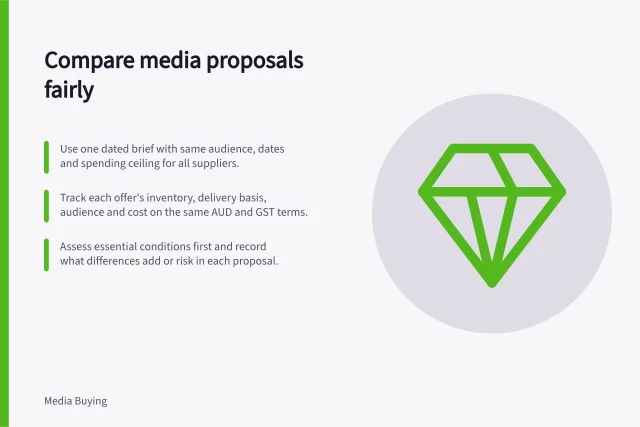
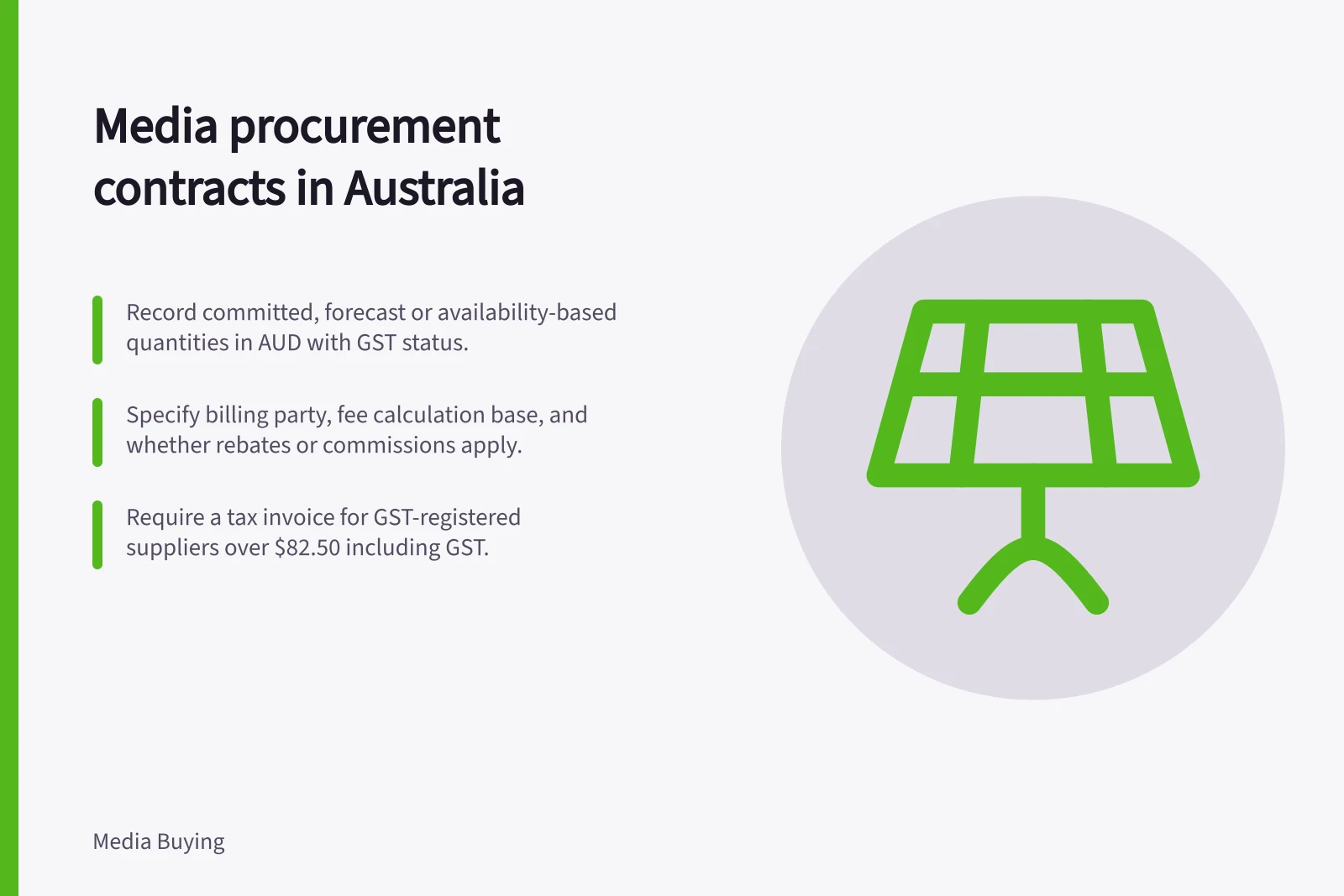
For each buy, record the Australian market, named placement or eligible inventory, format, flight, delivery unit, quantity, price basis and approved amount. Label quantities as committed, forecast or subject to availability. Ask which proposal statements become contractual commitments, then approve the version with the final answer.
Where a platform uses named transaction types, confirm in the applicable product documentation and agreement what each label means for inventory commitment and bidding. The labels do not settle the creative, targeting, billing or remedy terms of an advertiser’s agreement.
Approval question / Record to retain
- What may run?
- Placement or eligible inventory, format, market and exclusions
- What is promised?
- Unit, quantity, flight and commitment status
- What will be paid?
- Amount, currency, GST basis, fee calculation and billing party
- Who may act?
- Booking, access, creative and spend-change approvers
- How will it be checked?
- Report fields, delivery definition and exception contact
Make costs and changes clear
State amounts in AUD and whether each figure includes GST. Where the offer discloses them, identify inventory, buying-service, platform, data, production and reporting charges. For an all-in package, record the deliverable, total payable amount and the cost detail the advertiser will receive. Do not invent an underlying inventory price.
Establish which party contracts with each supplier, receives invoices and credits, and approves substitutions or extra spend. Specify the calculation base for a percentage fee. Record whether rebates, commissions and related-company services apply, how they are disclosed and treated, and where the agreement documents that treatment. An incentive warrants scrutiny; it does not prove a recommendation is unsuitable.
Read the booking’s cancellation and makegood terms before relying on a platform pause or informal promise. Keep each approved change with its date and the line item it affects.
Cost transparency: what must be disclosed in an Australian media contract
- Inventory charges
- Explicitly stated if applicable
- Buying-service fees
- Disclosed as part of the total cost
- Platform and data charges
- Must be itemised where applicable
- Production and reporting costs
- Included in all-in package or separately listed
- Rebates and commissions
- Disclosed and documented in agreement
- GST treatment
- Clearly stated whether included or excluded
Secure accounts and records
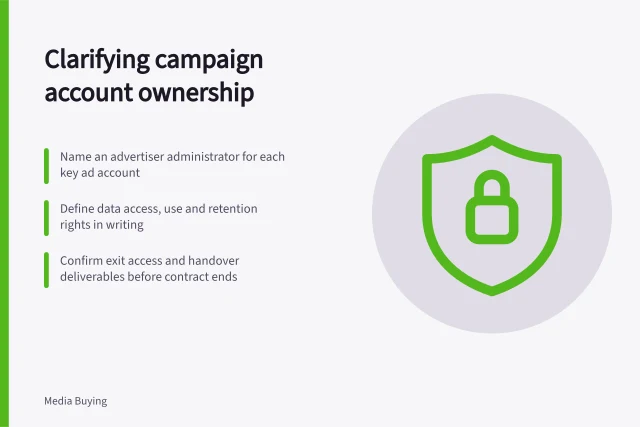
List the campaign accounts, analytics properties, tags, audience sources, creative files and reports needed to operate and review the buy. For each, record the administrator, operator access, permitted data uses and handover action. A platform’s use of owner does not determine contractual rights to every file or dataset.
For manager and client accounts, document account ownership, administrator access, data rights, and what happens to access and campaign activity if accounts are unlinked. Check account dependencies and maintain appropriate client-account administration before a handover is needed.
If campaign records contain personal information, assess the collection, use, sharing, security and retention arrangements against the Privacy Act 1988 (Cth) and the Australian Privacy Principles (APPs), where applicable. The APPs are the cornerstone of the Privacy Act’s privacy framework and govern personal information handling, including collection, use and disclosure, governance and accountability, integrity and correction, and individual access. The Office of the Australian Information Commissioner (OAIC) publishes the APPs. Specify how information will be retrieved and how copies will be handled at expiry.
Connect delivery, billing and handover
Agree on a stable order or line-item identifier and a report that can show what ran. For each billing period, compare the accepted commitment, dated delivery record and invoice using matching dates, units, currency and cost basis. Show replacement media, credits, refunds and approved changes separately.
For any platform, reconcile reporting fields to the invoice and the advertiser’s agreement. Confirm how fees, taxes, refunds and any client-facing markup are treated rather than assuming one spend column explains the charge.
If the supplier is registered for GST, require a tax invoice for a taxable sale over $82.50 (including GST), or when requested; the supplier has 28 days to provide one when requested. Check that it states “tax invoice”, the supplier’s business name and ABN, issue date, a description including quantity and price, and GST payable; for sales over $1,000 it must also show the buyer’s identity or ABN.
Log discrepancies with their source documents, affected amount or quantity, owner and resolution. At close, retain the signed terms, changes, final delivery and billing records, unresolved claims, account-access list and data handover record.
In this guide
- Recording inventory commitments line by line before signingDefine the placement, delivery unit, quantity and permitted changes before accepting a media order.
- Clarifying who owns campaign accounts and dataMap account administrators, data-use rights and handover steps before a media supplier starts work.
- Reconciling media invoices with delivery reportsMatch bookings, delivery exports and invoices by line item, period, unit and cost basis, then resolve exceptions.
- Managing conflicts of interest in media recommendationsIdentify agency incentives and related services, assess recommendations against the brief, and record approval and disclosure rules.