Supplier Evaluation
Part of Media procurement and contracts
Managing conflicts of interest in media recommendations
Identify agency incentives and related services, assess recommendations against the brief, and record approval and disclosure rules.
Before approving a media recommendation, make the agency’s relevant financial and organisational interests visible, review how they may affect the choice, and put disclosure and approval controls in the contract. Ask what the agency, its group or staff could gain from a proposed supplier or service, then assess the recommendation against the advertiser’s brief.
Identify the interest
An agency may receive a rebate, commission, discount or another benefit linked to spend. It may recommend a trading desk, data service or verification business within its group, while also buying media and reporting on delivery. These arrangements do not prove misconduct, but they justify asking how the recommendation was made and checked.
The ACCC’s 10 March 2020 inquiry launch identified questions about access to information on pricing, rebates and revenue flows, as well as supplier behaviour, including vertically integrated suppliers preferencing their own services and ad tech services businesses or ad agencies not acting in the best interests of their clients. These were matters for inquiry, not findings about a particular agency or recommendation.
The ACCC published its Digital advertising services inquiry - final report on 28 September 2021. IAB Australia’s overview says Recommendation 2 proposed giving the ACCC powers to develop sector-specific rules addressing conflicts of interest and competition issues in the ad tech supply chain; this was a recommendation to Government, not an existing sector rule.
The Media Federation of Australia’s Transparency Framework for Agencies and Advertisers was developed with the AANA to help members and clients discuss operating terms. Its page describes guidance on rebates, agency commissions, value banks, agency trading decks and ethics training. Use those topics to frame questions, not as proof that a particular interest was disclosed or that a contract meets a prescribed requirement.
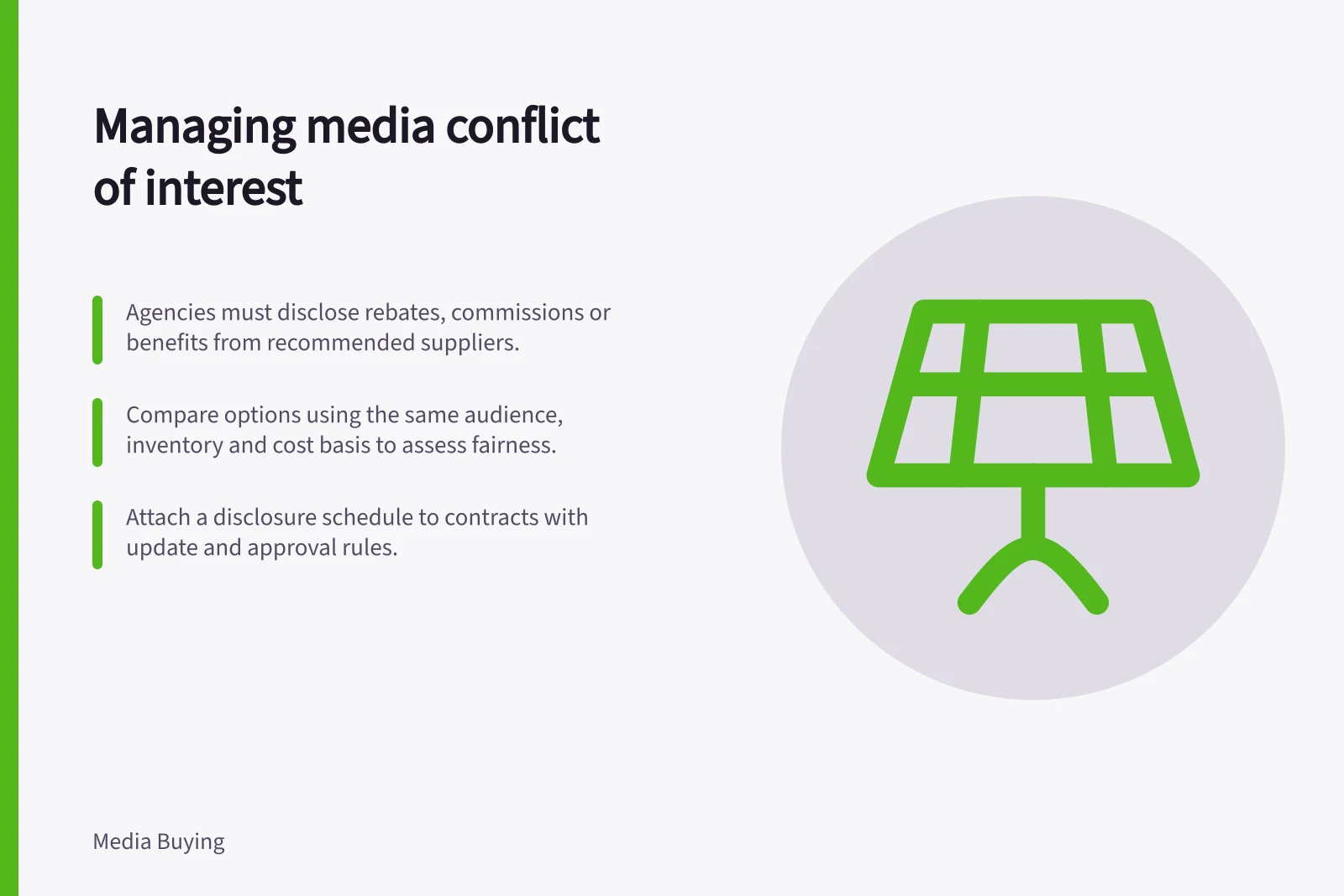
Request a campaign-specific disclosure covering the relevant agency, holding company and related services. Ask what form a benefit takes, what triggers it, who receives it, how the client agreement treats it, and whether the amount or calculation method can be disclosed. If an exact supplier benefit cannot be disclosed, record what can be and decide whether the remaining uncertainty affects approval; do not treat an undisclosed amount as zero.
Key regulatory insights from Australian sources
- ACCC Inquiry Launch
- 10 March 2020
- IAB Australia Recommendation 2
- Proposed ACCC powers to create sector-specific rules on conflicts
- MFA Transparency Framework
- Guidance on rebates, commissions, value banks and ethics training
Assess the recommendation
Compare feasible options against the same advertiser need, eligible audience, inventory and delivery basis, including total payable cost. Ask why an interested or related-party option was preferred and what evidence supports that choice. A lower headline rate may come with different placement or evidence; an affiliated service may still fit the brief when its role and terms are clear.
For each material recommendation, record:
- The advertiser need it addresses.
- The relevant interest disclosed, or a statement that none was disclosed.
- The alternatives considered and the reason for the choice.
- The person authorised to approve, challenge or decline it.
Add a recommendation record with the campaign and date, proposed supplier or service, relevant agency or group entity, disclosed benefit and recipient, reason for the choice, options considered, supporting evidence, decision, approver and any approval conditions. Note any information that remains unavailable so the approver can judge whether it matters.
This record supports an approval decision. It is not proof that an undisclosed interest does not exist.
Set an ongoing response
Attach a disclosure schedule to the agreement for each material recommendation. Record the supplier or service, relevant agency or group entity, benefit and trigger, recipient, how the benefit is treated—passed through, retained or credited—and any undisclosed detail or limitation.
Add a disclosure and change-notice clause requiring the agency to update the schedule when an interest changes, including after a supplier substitution or the addition of a related-company service. Require the advertiser’s written approval before that substitution or service proceeds.
An audit clause can permit inspection of records supporting the disclosed interest and its contractual treatment. Define the relevant records, period, notice, confidentiality and process for resolving discrepancies; include a remedy for a material undisclosed benefit, such as withdrawing approval, requesting a revised proposal or terminating the affected service.
For a material choice, arrange an independent review by someone not involved in the recommendation. Set the review question, records the reviewer may inspect, timing and who receives the outcome; match the review to the spend and significance of the interest.
If the benefit or decision basis remains too unclear to approve, defer the affected line item or request a revised proposal. Keep the disclosure, recommendation record, approvals and updates with the contract, and revisit them if later delivery or billing raises a relevant question.