Media Planning
Media buying models
Compare inventory routes, in-house and managed execution, and the charges and commitments behind a media buy.
A media buying model has three parts: how inventory is bought, who runs the campaign and how the advertiser is charged. Compare these separately. A publisher deal can be transacted through a platform, while an agency can manage either a publisher booking or a platform buy.
Choose a route to inventory
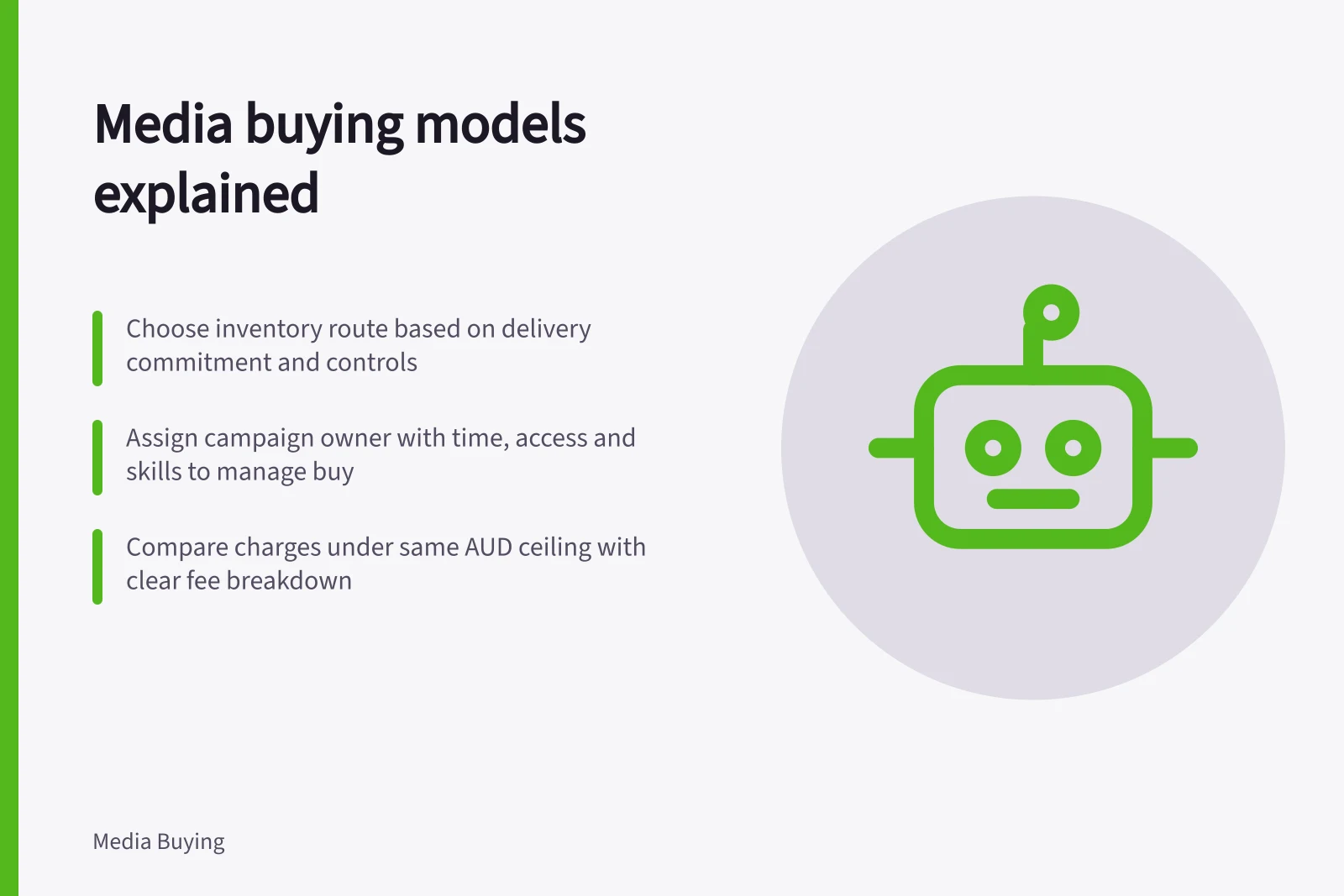
Inventory is available through publisher arrangements or platform-based transactions.
| Route | Approval question |
|---|---|
| Direct publisher booking | What placement and delivery has the seller committed to? |
| Open or private auction | Which inventory is eligible, and what controls and reports are available? |
| Preferred deal | What price and inventory are offered, and what are the terms? |
| Programmatic Guaranteed | What inventory and terms are specified, and what setup is required? |
These routes are not quality grades. Choose against the campaign's required context, available inventory and actual terms.
Understand the mechanics behind a programmatic buy
Programmatic buying automates how and when online ads are served. An advertiser sets parameters such as budget, target audience and campaign goals, then the platform uses an algorithm to match those settings with available inventory. This can make buying across websites less dependent on selecting placements individually.
In real-time bidding, an ad exchange facilitates transactions between supply-side platforms (SSPs), which represent supply, and demand-side platforms (DSPs), which represent advertisers. The exchange matches available placements with advertiser bidding parameters, and inventory is sold to the highest bidder. The matching process can happen within milliseconds.
Before choosing this route, check that available inventory and reporting suit the campaign; automation does not remove that need.
Decide who runs the buy
An in-house team, an agency or a hybrid arrangement can plan, operate and review a campaign. Assign an owner for inventory selection, negotiation, setup, creative approval, live changes and reporting.
Check that the people assigned have the time, access and skills to do the work. The advertiser should retain clear approval of the objective, spending limit and evidence it needs, whichever team operates the buy.
Read the charges separately
Compare proposals under the same AUD spending ceiling and stated GST basis. Identify inventory, platform, data, verification, production and buying-service charges, including anything bundled into an all-in price.
An itemised fee needs a stated calculation base; an all-in price needs a clear deliverable and disclosure of what cost detail the advertiser will receive.
For programmatic display, ask how media costs are reported and what cost and seller information can actually be provided.
Separate buying routes from charging models
Paid advertising commonly uses pay-per-click (PPC) and cost-per-mille (CPM) models. These describe charging approaches, whereas direct bookings, auctions and programmatic deals describe routes or transaction types. Keep those distinctions clear when comparing proposals, and confirm how the proposed charge is calculated.
Record the decision
For each feasible option, compare the inventory offered, the delivery commitment, the team responsible, the total payable amount and the reporting available. Record the chosen route, operator, fee basis and limits together.
In this guide
- Comparing managed buying with in-house executionCompare managed, in-house and hybrid media buying by tasks, capacity, control, full cost and reporting access.
- Separating media inventory costs from service feesClassify inventory, platform, data and buying-service costs, check fee bases and understand limits on publisher-revenue visibility.