Supplier Evaluation
Part of Media quality and brand suitability
Reviewing off-brief placements in a delivery report
Investigate and document placements that differ from the approved media brief without overstating report coverage.
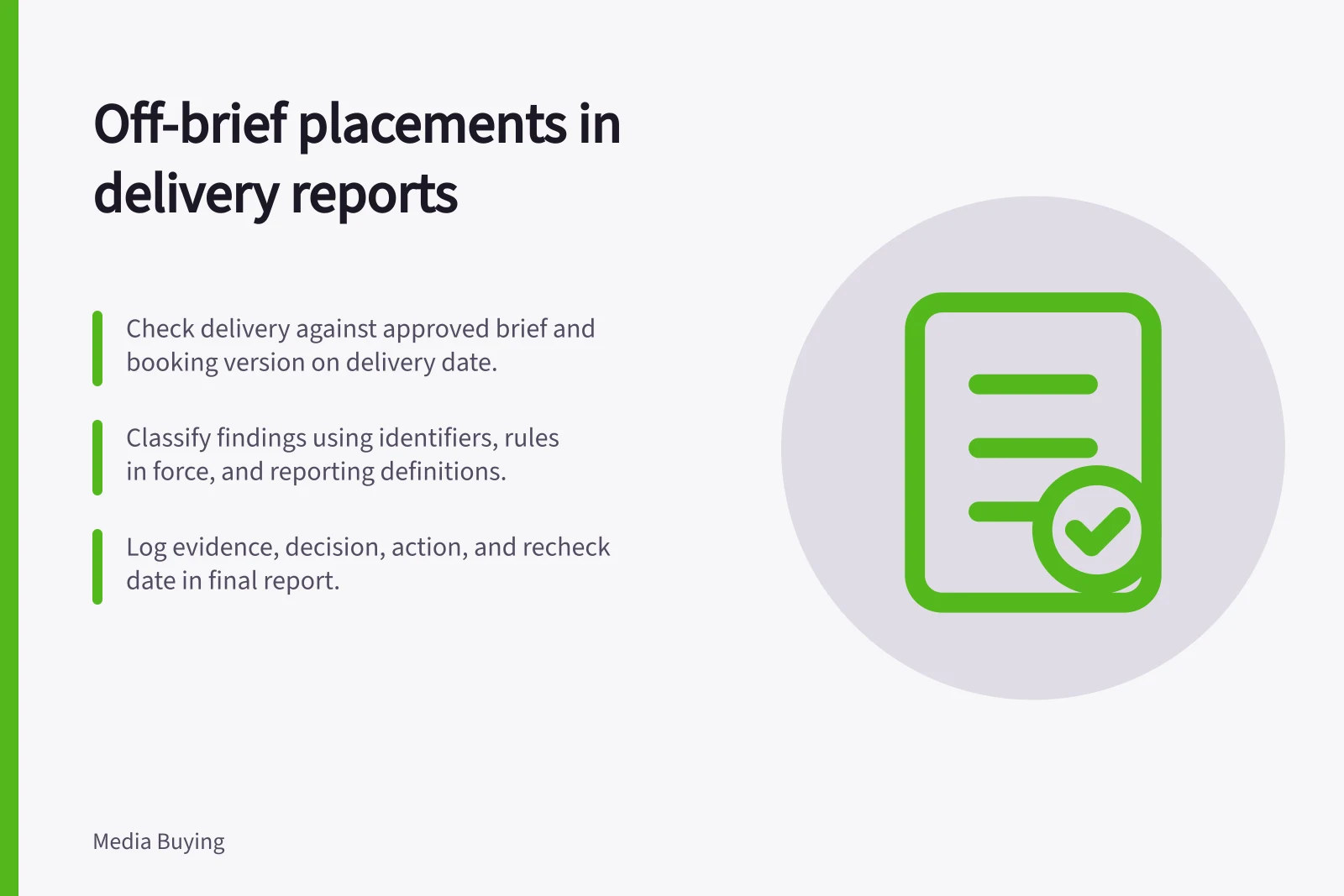
Check a suspected off-brief placement against the approved standard and the booking version in force on its delivery date. Decide first whether the row is a confirmed exception, an approved change or a reporting gap. Then establish the affected delivery and agree on a correction or a qualified final account.
Assemble the comparison
Keep the approved brief, accepted booking and amendments, and dated delivery export together. Connect them through campaign and line-item identifiers. Record the export’s time zone, inventory field, delivery unit and filters. A campaign total without placement detail cannot settle a question about a named context.
For each questionable row, capture the available property, app, video or other identifier; dates; format; reported quantity; and the exact rule that appears to have been breached. A screenshot may help establish context, but it cannot establish the total volume delivered there.
Classify the finding
| Finding | Next check |
|---|---|
| Property, format, date or exclusion appears outside approval | Confirm identifiers and any dated amendment. |
| Context appears unsuitable | Review the content against the rule in force at delivery. |
| Property or context is unclassified | Ask what the field represents and whether more detail exists. |
| Placement is absent from the export | Check thresholds, coverage and aggregation before concluding it did not run. |
| Quantity appears inconsistent | Match period and counting rule; use the agreed billing record for billing questions. |
An unidentified placement is not proof of a breach.
Check each report’s definitions, coverage and aggregation before using it to classify an exception. Do not treat unmatched totals as proof of a placement breach. Another supplier needs its own reporting definitions.
Investigate and correct
For a confirmed exception, ask for the affected dates and quantity under the agreed unit, the control or booking condition involved, and whether other placements share the issue. A changed setting, an unrecorded authorised substitution or a classification delay may be worth investigating; none is established until supported by the records.
If the placement remains live, stop or narrow the affected activity, correct the rule and check the next available delivery extract. Keep the original and revised settings with effective times. Any substitute media, credit or other remedy depends on the applicable agreement; a report finding alone creates no particular right.
Close the record
Log the approved rule, observed row, evidence, affected period and quantity if known, supplier explanation, decision owner, action and recheck date. Mark unknown quantity as unknown. In the final campaign report, distinguish confirmed off-brief delivery from unresolved placement visibility and acceptable delivery that performed poorly.