Media Planning
Media quality and brand suitability
Set placement and brand suitability standards, interpret verification carefully and review delivery against the approved brief.
Media quality asks whether paid activity ran in a legitimate, usable placement. Brand suitability asks whether the placement and its surrounding content fit this advertiser.
Set the standard before buying, check the controls available for each channel, then compare delivery with what was approved. A suitable context does not prove that an ad was noticed or produced a result.
Decide what is acceptable
Define content the business must avoid, content that needs review and content it accepts. Make the decision specific to the campaign's message and the Australian market. Set out the advertiser's risk tolerance and distinguish content to exclude from material that may warrant review.
Record the standard in terms a buyer can use: eligible properties or inventory, relevant sections or themes, formats, geography, adjacency requirements and exclusions. Include acceptable examples so a broad topic rule does not unnecessarily remove suitable journalism. Name the person who decides borderline cases.
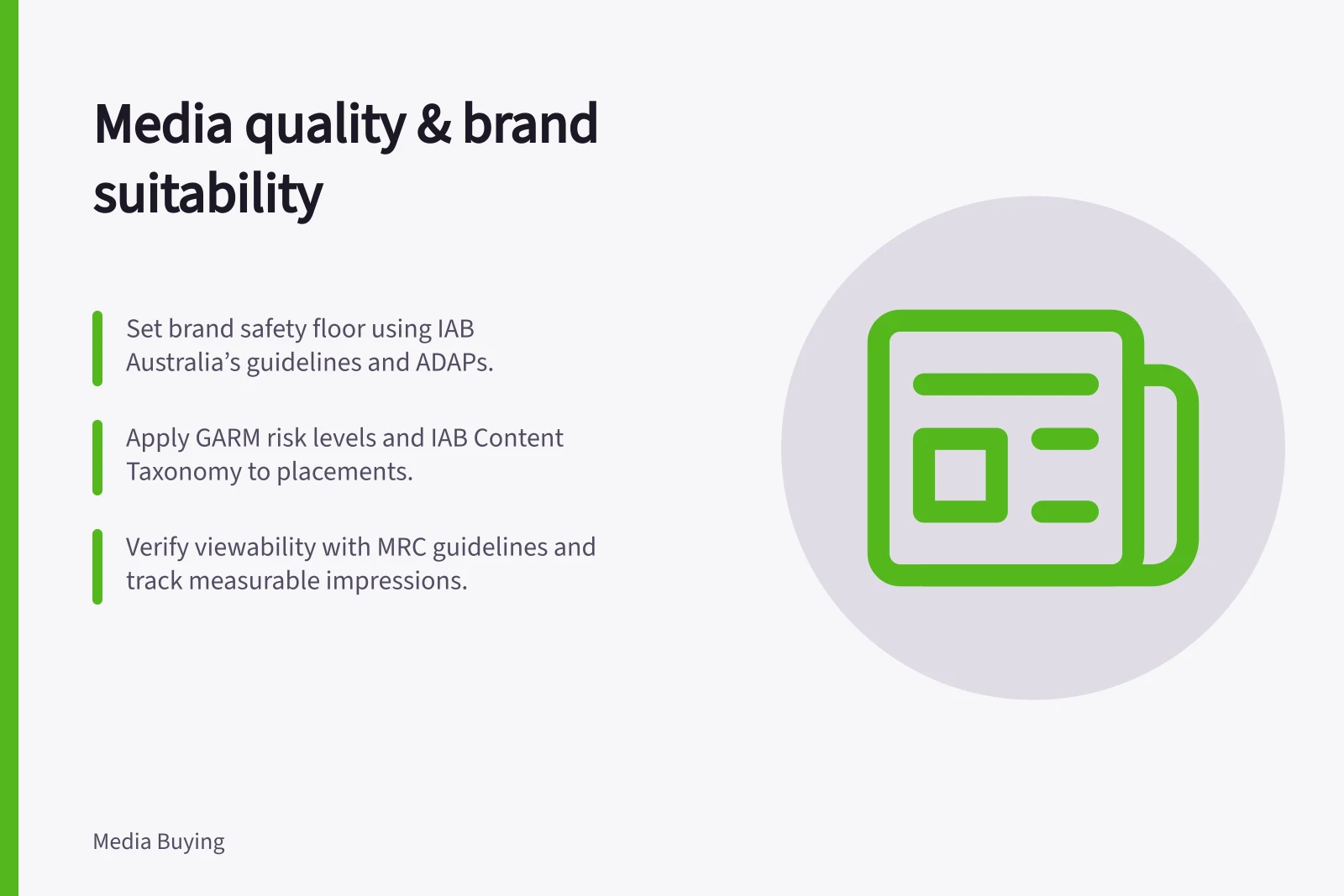
IAB Australia’s Brand Safety & Suitability guidance describes the Brand Safety Floor as the absolute minimum content-quality threshold a brand is willing to associate with. The Australian Digital Advertising Practices (ADAPs) were updated in 2020 with the MFA and AANA, bringing advertisers, agencies, publishers and subject matter experts together around local digital advertising practices.
For shared terminology, the GARM brand safety and suitability standard sets out 11 content categories and four risk levels: low, medium, high and floor. IAB Tech Lab’s Content Taxonomy provides a basis for labelling content, but no one framework covers every use case and channel, particularly user-generated content.
Name an advertiser-side decision owner for borderline cases and record the agency, publisher or platform contact who can help resolve them. Set out how an unresolved case reaches that owner before the campaign starts.
| Quality question | Standard to agree | Evidence to request |
|---|---|---|
| Context | Which environments and adjacent topics are acceptable? | Available placement and context detail |
| Inventory | Which properties, apps, units or pools are eligible? | Booking and placement identifiers |
| Delivery | What event counts as delivered? | Dated report and counting rule |
| Verification | Which activity can be assessed for viewability, invalid traffic or suitability? | Definitions, coverage and unmeasured share |
| Exception | What triggers review or correction? | Decision owner and escalation record |
Treat these as questions for the buying arrangement, not fields every supplier can provide. Record unavailable information as a coverage gap rather than assuming it meets the standard.
Key Elements to Define for Brand Suitability Standards
- Content to avoidExplicitly define prohibited topics or themes relevant to Australian market context
- Content requiring reviewIdentify borderline or sensitive topics needing human assessment
- Acceptable contentInclude examples of suitable journalism and approved formats
- Decision owner for exceptionsName individual responsible for resolving ambiguous placements
Apply the standard
Apply the agreed standard to each medium, noting its available inventory definitions, controls and reporting limits. Detailed placement specifications belong in the channel plan.
For each channel, check which content labels and suitability exclusions the buying platform and publisher support, and record any limits. Do not assume the same framework or classification is applied consistently across channels, especially for user-generated content.
Check current platform documentation before relying on a setting. Record its scope, limitations and any exceptions relevant to the campaign.
Treat verification as bounded evidence
For measurable digital ads, viewability indicates an opportunity to see the ad under a stated threshold. It does not establish attention. Ask for both the viewable share of measurable impressions and the share of total impressions that could be measured.
The Media Rating Council’s Viewable Ad Impression Measurement Guidelines, Version 2.0, provide a named reference for viewability. Agree the definition and method used for the campaign, and ask the reporting platform or ad verification partner to identify them alongside the figures.
Invalid-traffic filtration and suitability classification answer different questions. Keep each figure's format, dates, definition and coverage beside it.
Viewability Metrics and Measurement Coverage
- Viewable share of measurable impressionsRequired for assessing opportunity to see ad
- Share of total impressions that could be measuredIndicates measurement coverage gap
- Invalid traffic filtrationSeparate metric from suitability and viewability
Review exceptions while action is possible
Compare dated delivery with the approved standard. Separate confirmed off-brief activity from an unclassified row, a measurement gap or a metric below target. Ask what ran, when it ran and what correction is available. Preserve the original booking and record later changes with their effective dates.
When a placement is classified using GARM risk levels or the IAB Tech Lab Content Taxonomy, keep that classification with the delivery detail and compare it with the campaign’s approved threshold. For user-generated video, keyword analysis and natural language processing without human review can leave room for false positives and low precision.
A missing placement row is not proof that no ad ran. Treat delivery reports as evidence with defined coverage, rather than assuming they are exhaustive or suitable for billing. Ask each supplier what its own report omits. Close the review by recording what must stop, what can be corrected during the flight and what remains uncertain.
Reviewing Delivery Against Approved Brief
- Compare delivery with approved standardCheck dates, placement, and classification against brief
- Distinguish unclassified rows from gapsIdentify missing data vs. non-delivery
- Record corrections and uncertaintiesNote what can be fixed during flight, what must stop, and what remains unclear
In this guide
- Defining placement standards across channelsTurn brand suitability rules into placement specifications buyers and suppliers can apply and check across channels.
- Comparing viewability and verification metrics carefullyCompare viewability, invalid-traffic and suitability figures using their denominators, coverage and format limits.
- Reviewing off-brief placements in a delivery reportInvestigate and document placements that differ from the approved media brief without overstating report coverage.
- Balancing suitability controls with useful audience reachAssess how suitability exclusions affect eligible inventory and audience opportunity while preserving essential brand protections.